EDITORIAL NOTE: This article is based on the government’s official support package announcements. Sources: The Straits Times, 29 July 2026 and singaporebudget.gov.sg.
What the Government Has Actually Announced
Since April 2026, the government has rolled out two packages of support measures in direct response to the Middle East situation, which has kept global energy prices elevated and put pressure on the cost of basic goods.
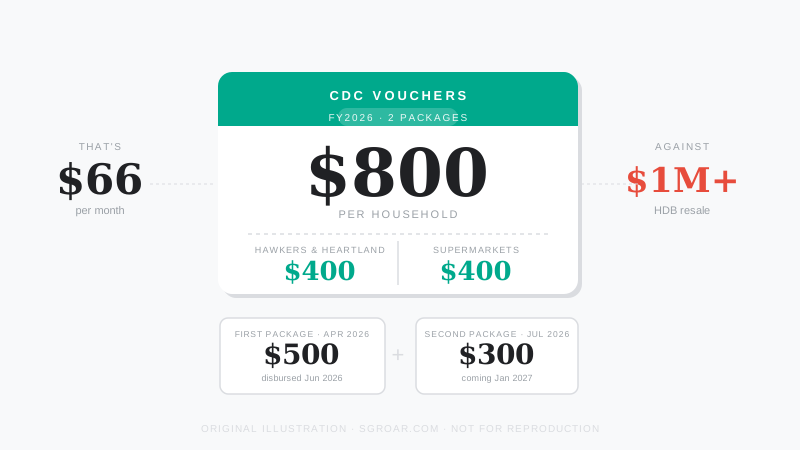
Here is what every Singaporean household is receiving in CDC Vouchers across FY2026:
First package (April 2026): $500 in CDC Vouchers — originally announced at Budget 2026 for January 2027, brought forward to June 2026 in response to the Middle East situation. Split equally — $250 for heartland merchants and hawkers, $250 for supermarkets.
Second package (July 29, 2026): An additional $300 in CDC Vouchers, coming in January 2027. Again split equally — $150 for heartland merchants and hawkers, $150 for supermarkets.
Total: $800 per household for FY2026.
The second package — announced by Second Minister for Finance Jeffrey Siow and Senior Minister of State Low Yen Ling on July 29 — also includes up to $190 in additional U-Save rebates in October 2026 and January 2027, ComCare Interim Assistance for lower-income households, a one-off SME cash grant, and rental support for hawker stalls and market stallholders.
Taken together with the first package, government support now amounts to around $2 billion on top of Budget 2026 measures.
The trigger has been consistent: the situation in the Middle East remains volatile. Disrupted shipping lanes and elevated oil prices have pushed up the cost of energy, certain imported goods, and the daily essentials that ordinary Singaporeans buy every week. As Siow noted, Singapore’s economy has held up — 6.3 per cent growth in Q1 2026, 5.7 per cent in Q2 — but the performance has been uneven, and SMEs and lower-income households are feeling the pressure most acutely.
What the Government Got Right
Let’s be clear about what is working.
The response has been proactive. Two packages in four months, both explicitly tied to a specific external trigger, both disbursed quickly. The first package prioritised speed. The second was more targeted. That sequencing — broad relief first, focused support second — is sensible crisis management.
The CDC Voucher design is thoughtful. The equal split between hawkers and heartland merchants on one side, and supermarkets on the other, is deliberate policy, not arbitrary. Independent hawkers and provision shops — often elderly operators with thin margins — benefit directly. So do residents who rely on them. At the same time, the supermarket allocation gives households flexibility for groceries and daily staples. Neither constituency is sacrificed for the other.
It reaches every household, not just the very poor. Unlike means-tested schemes that can carry stigma and bureaucratic friction, CDC Vouchers go to every Singaporean household. A family in Tampines and a family in Toa Payoh receive the same amount. There is something fundamentally decent about that — a reminder that the social compact is not only for those who have already fallen through the cracks.
The scheme has improved with each iteration. From physical voucher books to QR codes, the redemption process is faster, simpler, and more dignified. The scheme’s continued expansion and year-on-year refinement suggests the design is landing — governments do not keep improving what people are not using.
But Here Is the Arithmetic Problem
$800 is meaningful support — and the government has made no pretence otherwise. Of the June $500 tranche, the $250 allocated to hawkers and heartland merchants genuinely offsets food costs for weeks of eating out. The $250 for supermarkets is a real reduction in the grocery bill. The scheme reaches people where they already spend.
But measured against Singapore’s major recurring expenses — housing, transport, utilities, and food across a full year — $800 remains temporary relief rather than a structural solution.
Here is the other side of the ledger:
- HDB resale flat prices have crossed the million-dollar mark in multiple transactions. Five-room flats in mature estates regularly transact above $700,000. Million-dollar HDB transactions, once exceptional, have become increasingly common.
- Grocery prices have risen steadily. A basket of basics at a supermarket today costs meaningfully more than it did three years ago.
- Hawker prices, once Singapore’s great equaliser, have crept up. $5 chicken rice is not unusual. $4 is increasingly rare.
Against this backdrop, $800 in annual vouchers is not a cure. It is, at best, a cushion — and an honest one. The government has not pretended otherwise. But a cushion and a solution are different things, and Singaporeans are entitled to ask for both.
The Structural Problem Vouchers Cannot Fix
The cost-of-living pressure in Singapore is not principally a problem of weekly grocery bills. For many households, the deeper concern is recurring structural costs — particularly housing, healthcare and transport — that feel increasingly out of reach for those in the middle and lower rungs.
Housing is the central issue. A 4-room BTO flat costs hundreds of thousands of dollars. Against that, $800 in annual vouchers covers a small fraction of the downpayment, let alone the loan. The voucher did not help a young couple save for their flat. It will not help them service it. It buys them time at the hawker centre, not equity in a home.
Wage growth has not kept pace for everyone. Singapore’s median household income has grown. But for lower-quartile households — the families the CDC Voucher scheme most needs to help — whether wages have meaningfully kept pace with the rising cost of essentials remains a live and unresolved concern. A voucher helps at the margin. It does not rebuild the margin.
GST rose anyway. GST increased in two steps: from 7% to 8% on 1 January 2023, and from 8% to 9% on 1 January 2024. CDC Vouchers form one part of the Government’s broader Assurance Package of GST offsets — which also includes cash payouts, MediSave top-ups, and utility rebates. That broader package is real support, and it deserves acknowledgment.
But the underlying distinction holds: one-time distributions do not offset a permanent structural cost increase. Every week, on every purchase, the additional percentage compounds. The voucher runs out. The tax does not.
This is not an accusation of bad faith. It is an observation about design. Temporary relief and permanent cost are not equivalent, even when presented as balancing each other out.
What Else Could Work?
Singapore has options. Most of them are harder than issuing vouchers — which is precisely why they have not been fully pursued.
On housing: The most direct intervention is supply. Build more, faster, at lower price points. The government has announced increased BTO supply, which is the right direction — but pipeline effects take years to reach the resale market. In the meantime, price benchmarks and income ceiling adjustments could be used more aggressively to keep BTO within genuine reach of median earners.
On wages: Workfare and Progressive Wage Model extensions are structural — they lift the floor permanently, rather than handing out money that gets spent once. Expanding both in scope and quantum would do more lasting good than voucher increases.
On essential goods: Price monitoring frameworks with major supermarkets exist. Making them more robust — with clearer benchmarks for staple goods — is a lever the government has not fully pulled. Not price controls, which distort supply, but transparent accountability for essential basket pricing.
On GST: An exemption for a defined basket of essential goods — fresh produce, basic staples — is used in many comparable economies. It is a permanent, weekly cost offset that compounds in the household’s favour. The Government has historically preferred targeted transfers over differentiated GST rates, arguing that tiered rates are administratively complex and can disproportionately benefit higher-spending households. That argument has merit. But whether essential staples deserve a carve-out remains a legitimate policy question worth asking.
Our Take
The CDC Voucher scheme is not cynicism dressed up as generosity. It is genuine generosity that is genuinely insufficient.
Across two packages in four months, the Government brought forward $500 in previously announced CDC Vouchers and added a further $300 per household — alongside a broader $2 billion support envelope. That is a government that has moved, and moved quickly. The CDC Voucher design is thoughtful, inclusive, and smartly targeted at the local businesses that need it most. That deserves credit.
But Singaporeans are adults. They can hold two thoughts at once: thank you for the voucher and this does not fix what we are worried about.
The real question is not about the voucher itself. It is about whether the structural pressures — housing costs, wage growth, the cumulative weight of GST — are being addressed with the same urgency and creativity that produced $2 billion in relief in four months.
Vouchers are a gesture of good faith. What Singaporeans need alongside them is evidence of structural change.
Have a view? Comment below — and share this piece if you think more Singaporeans should be asking these questions.
Comments